If you have been researching driveway, path or pool surround options, you have likely seen the term resin-bound. It is often confused with resin-bonded systems or indoor resin floor coatings, but they are different products with different uses.
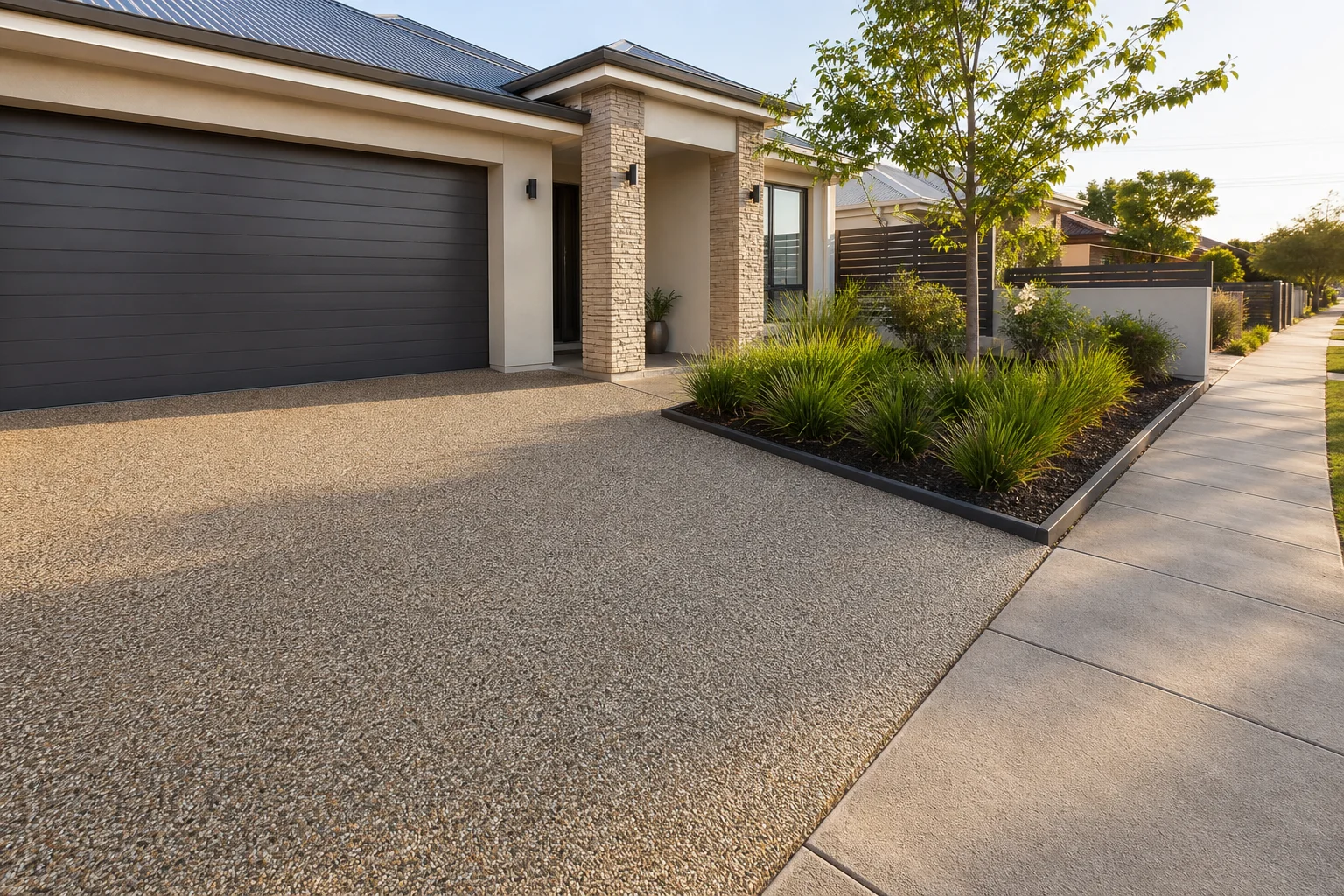
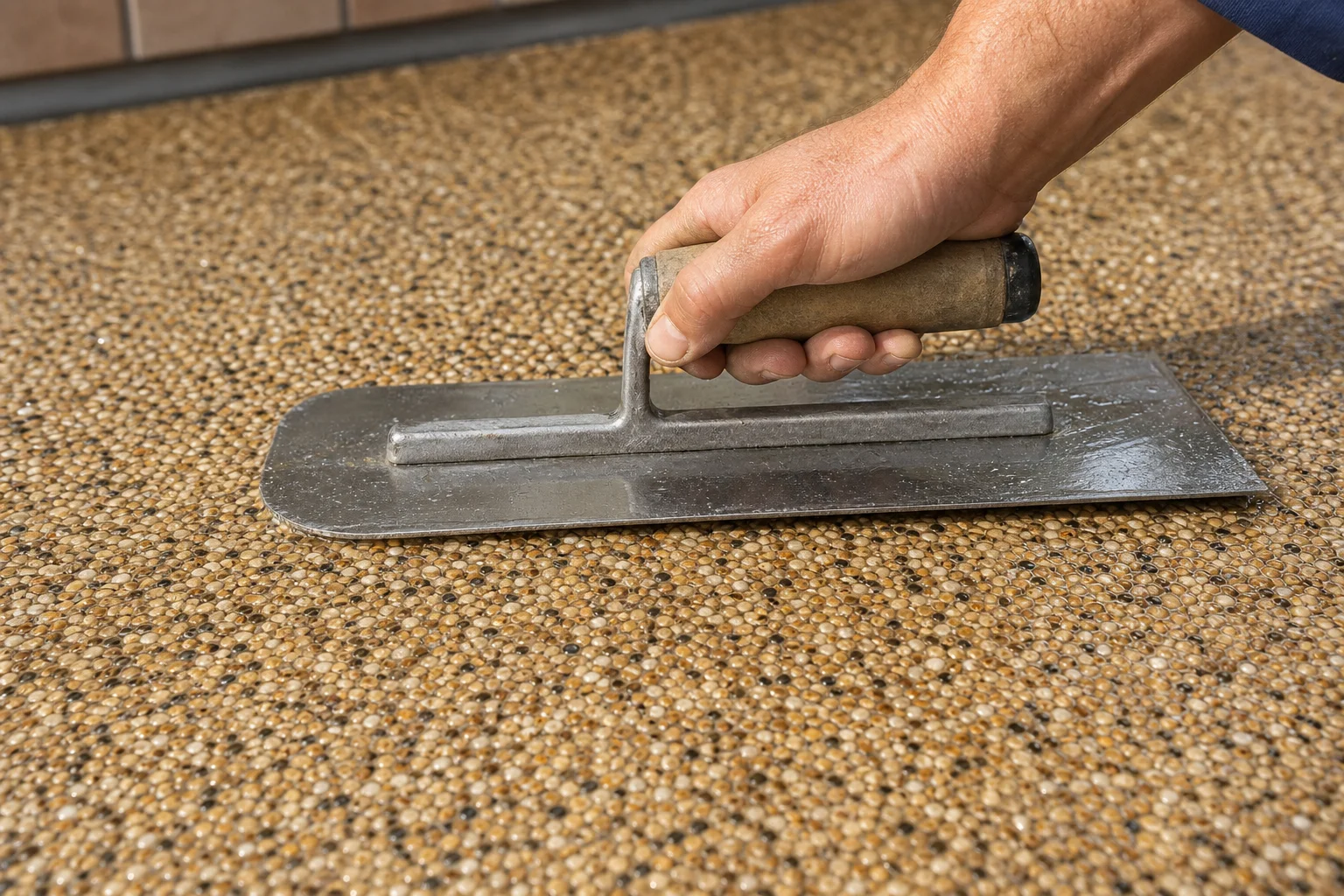
In plain English, resin-bound paving is a surface system made by mixing natural stone aggregate with UV-stable resin, then trowel-applying it over a prepared base to create a joint-minimised stone-textured finish. The surface layer is porous, but complete drainage depends on the base, sub-base, falls, outlets and wider site design. Routine care is still required.
The 30-Second Version
- Natural stone aggregate is mixed with UV-stable resin and hand-trowelled.
- It creates a joint-minimised, natural-stone outdoor finish.
- It is used for driveways, paths, patios, pool surrounds and other qualifying outdoor areas.
- The surface layer is porous; complete permeability requires a suitable porous base, sub-base and drainage design.
- Installation timing depends on preparation, weather, curing conditions and project scope.
- No universal lifespan applies; service life depends on the base, installation, use and maintenance.
What Resin-Bound Is Made Of
1) Aggregate
Aggregate is the visible stone component. For outdoor resin-bound work, aggregate selection should match appearance goals, durability requirements and grading suitability for the intended use.
Suitable aggregate is generally dry, consistently graded and selected for outdoor exposure. The exact blend and size are chosen around project use, aesthetics and specification.
2) Resin
Resin is the binder that locks aggregate together. Gorilla Surfaces uses a UV-stable outdoor resin selected to help reduce yellowing; no outdoor finish is fade-proof.
How Resin-Bound Is Installed
Step 1: Base assessment and preparation
Base condition is critical. Existing concrete, asphalt or other substrates are assessed for stability, cleanliness, moisture and movement before any overlay recommendation.
Step 2: Controlled mixing
Resin and aggregate are mixed in controlled batches to specification, then placed in a workable window suitable for accurate installation.
Step 3: Trowel application
The mixed material is hand-trowelled to a consistent depth with edge detailing around thresholds, borders and transitions.
Step 4: Curing and return to use
Keep people off for at least 24 hours and vehicles off for at least 48 hours, or longer if advised. Temperature, moisture, weather and project conditions can extend curing.
Why Homeowners Consider Resin-Bound
- Joint-minimised natural-stone appearance with broad blend options.
- Fewer joints where weeds commonly establish, reducing weed pressure.
- An aggregate-textured finish; no universal non-slip or AS/NZS classification is claimed without relevant testing.
- A porous surface layer, with whole-area drainage still dependent on the base and site design.
- Design flexibility for borders, inlays and colour transitions.
Where Resin-Bound Can Work Well
- Residential driveways in suitable base conditions.
- Pool surrounds where texture/specification matches wet-area requirements.
- Patios and outdoor entertaining zones.
- Garden paths and other qualifying outdoor routes.
Where It May Not Be the Right Option
- Severely compromised or actively moving bases.
- Applications with loading profiles outside suitable specification.
- Projects where substrate condition requires deeper reconstruction first.
A good assessment should identify these limitations early rather than force-fit the wrong system.
How It Compares to Other Surfaces
| Surface | General profile | Permeability context | Maintenance profile |
|---|---|---|---|
| Resin-bound | Joint-minimised natural-stone finish with design flexibility | Porous surface layer; whole-area drainage depends on the base and site design | Routine care depends on use and site conditions |
| Concrete | Traditional slab finish options | Generally non-permeable slab systems | Varies by finish and condition over time |
| Block paving | Jointed paver layout with pattern flexibility | Varies by system and joint/base design | Joint maintenance and weed management often required |
| Asphalt | Functional dark surface | Generally non-permeable | Condition-based patching and maintenance over time |
This comparison is educational. Gorilla Surfaces installs resin-bound resurfacing only; it does not install resin-bonded systems, concrete, block paving or asphalt.
Resin-Bound vs Resin-Bonded (Quick Explanation)
Resin-bound mixes stone and resin before laying, creating a porous, smoother finished layer. Resin-bonded applies resin first and broadcasts stone on top, creating a more textured surface that is generally non-porous. Whole-area drainage still depends on the complete site design.
Gorilla Surfaces installs resin-bound resurfacing only. Resin-bonded systems are included here for comparison and are not part of the service offered.
For a dedicated comparison, read resin-bonded vs resin-bound, and if your project involves an existing slab, review driveway resurfacing suitability.
Overlay Suitability: Concrete, Asphalt and Other Existing Surfaces
Stable existing concrete or asphalt may qualify for a resin-bound overlay after assessment. Gorilla Surfaces does not construct new bases or install the system directly over dirt.
Stable pavers are considered selectively after both the pavers and supporting base are assessed. Tiled surfaces are higher risk and may not qualify for resurfacing.
How to Think About Cost Without Guesswork
As an initial planning guide, straightforward qualifying residential resurfacing may fall around $172–$200 per m². This is indicative only, and a minimum project charge based on 20 m² applies.
The written quote confirms the final price and included scope after the base, access, drainage, edges, aggregate selection, total area, preparation and design details have been assessed.
Photos are required before a site visit. Site conditions and measurements are then confirmed before a written quote is provided.
Is Resin-Bound Right for Your Property?
Resin-bound may suit a property where the existing base qualifies and a joint-minimised natural stone finish is preferred. The porous surface layer does not remove the need to assess falls, outlets and the wider drainage design.
It is not automatically the best choice for every site. Suitability should be confirmed by inspecting base condition, movement, access, edging and drainage requirements.
Frequently Asked Questions
What is resin-bound surfacing?
Resin-bound surfacing is made by mixing natural stone aggregate with UV-stable resin, then hand-trowelling the mixture over a prepared, suitable base to create a joint-minimised stone-textured finish.
Is resin-bound surfacing fully permeable?
The resin-bound surface layer is porous. A fully permeable installation also needs a suitable porous base, sub-base and drainage design. An overlay over ordinary concrete is not a fully permeable system.
Which existing surfaces may suit a resin-bound overlay?
Stable concrete or asphalt may qualify after assessment. Stable pavers are considered selectively, while tiled surfaces are higher risk. Gorilla Surfaces does not construct a new base or install over dirt.
How long before a resin-bound surface can be used?
Keep people off for at least 24 hours and vehicles off for at least 48 hours, or longer if advised. Temperature, moisture, weather and project conditions can extend curing.
What to Ask Before You Commit
- Is the system UV-stable and suitable for outdoor use?
- How will base condition and movement be assessed and addressed?
- How will the proposed preparation and edge details be documented?
- What is included, excluded and how are variations handled?
- How is curing and return-to-use timing set for this site?